The Hidden Cost of “Good Enough” Design in Commercial Spaces

In commercial design, “good enough” is often where businesses quietly lose money.
At first glance, choosing a lower-cost design solution, or rushing through the design process, can feel like a smart financial decision. Since budgets are tight and timelines matter, opening the doors sooner means generating revenue faster. Or so the thinking goes.
In reality, “good enough” design creates a ripple effect of hidden costs that affect long-term performance. Small inefficiencies, missed opportunities, and inconsistent customer experiences begin to add up over time, turning what seemed like upfront savings into ongoing revenue loss.

Cramped kitchen and inefficient workflow layout.
The Illusion of Saving Money
Cutting corners in design rarely shows up as a line item called “lost revenue.” Instead, it appears in small, easy-to-miss ways:
- A layout that slows down service during peak hours
- Inefficient back-of-house workflows that add extra steps
- Underutilized square footage that exists but does not actively generate sales
- Missed opportunities for upselling or product visibility
Individually, these issues seem minor. Together, they limit what the business can achieve each day.
In high-volume environments like dessert shops, boba tea stores, or ice cream concepts, efficiency is directly tied to revenue. When service is slightly slower, fewer orders are completed per hour. If products are not clearly visible or intuitively placed, customers are less likely to add on. A ill-devised layout creates friction, making staff compensate manually, often at the cost of speed and consistency.
There is no obvious breaking point, which is what makes it easy to ignore. But over time, these small inefficiencies compound, reducing what the space is capable of earning. What looked like savings upfront becomes an ongoing operational drain.

Underutilized space in a dessert shop design.
Where “Good Enough” Starts to Cost You
The impact of “good enough” design tends to show up in predictable ways. Not all at once, but across key areas of the business where small gaps turn into ongoing costs.
1. Rework: Fixing What Should Have Worked
One of the biggest hidden costs of “good enough” design is rework.
Businesses often revisit their spaces within months, not years, because something is not working the way it should:
- Customers do not flow naturally through the space
- Staff struggle with the layout during busy hours
- Equipment placement creates bottlenecks in production
- The space feels off, even if it is hard to pinpoint why
These issues rarely stop operations, but they still slow things down and affect both efficiency and customer experience. Over time, they add up and become harder to brush off.
What follows is rework. Walls are moved, counters are rebuilt, equipment is relocated, and layouts are rethought, all while the business is already open. In high-traffic spaces, even small adjustments can disrupt service and reduce daily revenue during the process.
Fixing these issues after opening is significantly more expensive than getting it right the first time. Construction disruptions, downtime, and redesign fees quickly outweigh any initial savings, turning an early compromise into a much larger investment later on.

Design rework during active restaurant operations.
2. Inefficiency in Everyday Operations
Inefficiency in design shows up in how smoothly a space runs during a busy shift. Here’s what that can look like in practice:
- Staff crossing paths behind the counter because prep, ordering, and pickup aren’t clearly separated
- A drink or dessert assembly line that adds unnecessary steps to every order
- Storage placed too far from where it’s actually used
- Customers forming unclear queues due to poor layout
All of this limits how much the space can handle. An extra few seconds per order adds up quickly during peak hours: fewer orders get completed, lines feel longer, and some customers walk away. On the staff side, inefficient layouts mean more movement, more fatigue, and often the need for extra hands just to keep up.
Over time, the business compensates by adding staff, slowing service, or capping output. At that point, the layout starts costing money every day.

“Good enough” design in action: frustrated customers and staff.
3. Brand Dilution Across Locations
For franchises and multi-location brands, inconsistent design becomes a brand problem over time.
Every location is a physical extension of the same brand, and customers expect that experience to feel familiar no matter where they walk in. When design starts to vary too much, that consistency breaks down in small but important ways:
- A store layout where the counter is in a different place, making the flow feel unfamiliar
- Different lighting or color palettes that change the mood of the brand
- Varying signage styles that make ordering feel slightly different each time
- Product displays that highlight different items depending on the location
Individually, these differences may not seem significant. But for customers, they create a subtle sense that the brand is not fully stable or intentional.
This matters even more in categories like boba tea shops, dessert concepts, and fast-casual dining, where the space itself is part of the product. Customers are not just buying what they order, they are also reacting to the environment, and often sharing it online. A store that looks different from city to city can weaken that “recognizable moment” people expect when they visit or post about it.
Strong design keeps the core experience consistent while still allowing flexibility across different spaces. “Good enough” design usually ends up doing neither, which is where brands start to feel diluted as they grow.
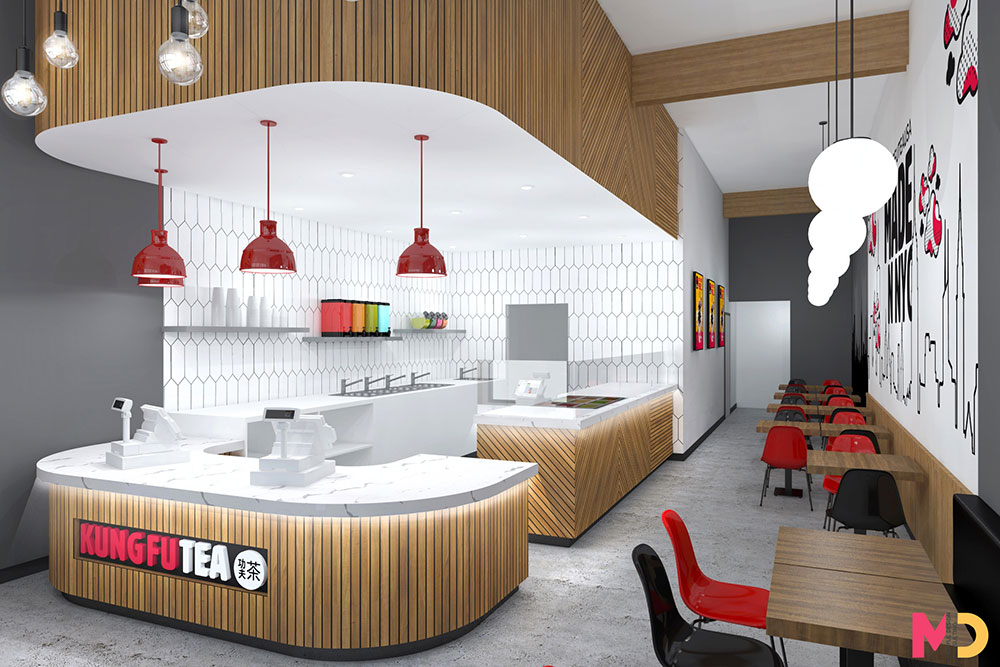

Well-executed Kung Fu Tea franchise design by Mindful Design Consulting, with consistent design across locations (Temecula and National City).
4. Missed Marketing Opportunities
Well-designed spaces quietly market the brand in the background every day.
From Instagram-friendly corners to intuitive ordering flows, design directly shapes how people interact with the space and whether they choose to share it. Small details often decide this more than people realize:
- A clear visual focal point near the entrance that naturally becomes a photo spot
- Seating or layout choices that encourage customers to stay longer without feeling forced
- A menu layout that is easy to understand quickly, reducing hesitation at the counter
- Lighting and finishes that make products like drinks, desserts, or packaging look more appealing in photos
Each of these moments influences behavior in subtle ways. A slightly longer stay often leads to an extra order. A more photogenic corner leads to organic social posts. A clearer flow reduces friction and keeps the experience moving smoothly.
A forgettable or poorly considered space does none of this work on its own. Customers are less likely to take photos, less likely to share their visit, and less likely to remember the experience in a meaningful way. In those cases, the business has to rely more heavily on paid marketing just to create the same level of visibility and awareness.

Good design: Lulu’s Ice-Cream Social design by Mindful Design Consulting, featuring an easily accessible selfie wall.
Good Design Is Part of Business Operations
The most successful commercial spaces treat design as an investment, not an expense. You can see it in spaces where things just run smoothly without extra effort: