
From First Location to Fifty: The System Behind Sustainable Growth

Scaling a franchise is exciting. New locations open, new markets respond, and momentum starts to build. But somewhere between the third store and the fifteenth, many founders notice something subtle: the brand doesn’t feel as tight as it once did. The logo is the same, the menu hasn’t changed, and the colors are technically consistent, yet one location feels intentional and polished while another feels slightly off, darker, louder, or less refined. This doesn’t usually happen because of marketing. It happens because the brand lacks franchise interior guidelines to protect it as it grows.

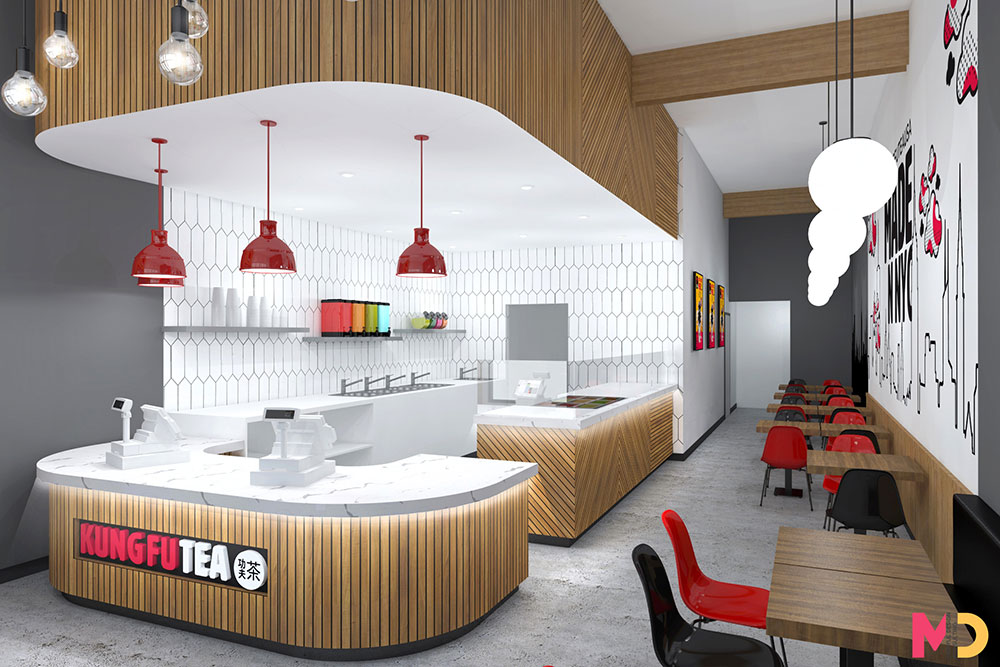
3D model of Kung Fu Tea Carmel Mountain Ranch location in San Diego, CA. Design by Mindful Design Consulting.
Growth Without Standards Dilutes the Brand
In the early days, everything is controlled. The founder is involved in every decision, materials are chosen carefully, the layout is deliberate, and lighting is considered. The space tells a clear story.
But as growth accelerates, the design starts to get interpreted by different architects, contractors, and franchisees. Small substitutions happen, layouts shift to fit a particular footprint, and finishes get adjusted to meet local budgets or timelines.
None of these decisions feel significant on their own, but over time they add up. The customer experience slowly changes, and the brand begins to feel less cohesive.
That’s how brand drift begins. It doesn’t come from one big mistake, but from dozens of small, unstructured decisions that slowly shift the identity of the brand.
3D model of Kung Fu Tea, Temecula, CA. Design by Mindful Design Consulting.
Lack of Consistency Erodes Trust
Customers may not consciously notice every design difference between locations, but they feel it. In franchise businesses, that feeling matters, because consistency is part of the promise. When someone walks into a dessert shop, boba tea store, or fast-casual concept with multiple locations, they expect familiarity. Predictability builds trust, and trust builds loyalty.
When one store feels modern and vibrant while another feels improvised or outdated, the brand promise becomes less clear. Over time, that inconsistency changes how people perceive the brand.
The impact is internal as well. Franchisees invest serious capital to open a location, and without defined interior standards they are forced to make design decisions without a clear framework. They rely on local consultants who may not fully understand the brand vision, and they end up questioning whether their store looks “right.”
That uncertainty creates friction and slows growth. Clear interior guidelines remove that ambiguity, giving franchisees confidence and giving brands control.

3D model of Kung Fu Tea, National City, CA. Design by Mindful Design Consulting.
What Franchise Interior Guidelines Should Include
Interior guidelines are often misunderstood as a collection of reference images or a beautifully assembled mood board. In reality, a true franchise design system goes much deeper. The guidelines are a practical playbook for how the brand shows up in physical space.
They should clearly define the layout, how customers move, where ordering happens, how seating is arranged, and how back-of-house functions without disrupting the experience. They need to specify core materials and finishes so the space feels consistent from one location to the next. Lighting standards matter too, because atmosphere changes everything. The same goes for signage placement, millwork details, furniture selections, and the key brand moments that make the space recognizable.
Just as important, the guidelines have to allow for flexibility. No two retail spaces are identical, especially in growing franchise systems. A strong design system protects the core identity of the brand while giving it room to adapt to different footprints and cities.
The goal isn’t to duplicate the exact same store over and over. It’s to create a clear framework so every new location feels aligned, intentional, and unmistakably part of the same brand.

3D model of Bobaroma boba tea shop, Gergetown, Ontario. Design by Mindful Design Consulting.
The Advantage Most Brands Overlook
Once a brand starts opening multiple locations, costs can balloon quickly because of repeated design work, approval back-and-forth, and construction surprises.
A good set of interior guidelines prevents this by giving everyone the same playbook. The design team isn’t reinventing the concept for every store, so fewer hours are spent on revisions and rework. That directly lowers design costs.
Approvals also move faster because drawings and specifications are consistent and predictable. When every store follows the same rules, landlords and permitting offices don’t have to relearn the concept each time. That reduces review cycles and speeds up the timeline.
During construction, having clear standards means fewer last-minute changes. When finishes, lighting, and fixtures are pre-approved, contractors don’t need to pause work while waiting for decisions. There’s less chance of substitutions that don’t match the brand or cause delays.
In short, guidelines make expansion smoother by reducing the things that usually slow it down, such as cost, approvals, and build-out time. Once a franchise is running on a system like this, scaling becomes far more predictable.
It turns out that what many founders initially see as an added design expense often becomes one of their most valuable growth infrastructures. Instead of reacting to inconsistencies, the brand operates from a system.

3D model of Bobaroma boba tea shop, Gergetown, Ontario. Design by Mindful Design Consulting.
The Right Time to Invest in a Franchise Design
Most brands wait too long to create a design system. By the time they notice inconsistencies, they already have several locations that look and feel slightly different, and the cost to fix it has grown significantly.
If you are opening multiple locations, preparing to franchise, or already noticing differences between stores, it is time to invest in interior guidelines. The best moment to do this is before customers start noticing the drift. Once inconsistencies are visible, correcting them across a network becomes far more complex and expensive.
For dessert concepts, ice cream brands, boba tea shops, and fast casual restaurants in particular, the interior is not just a backdrop, but a part of the product. Customers photograph it, share it, and connect it to the taste and the experience. While your logo may sit on the wall, your brand lives in the room.
Interior guidelines ensure that every new location strengthens your identity rather than diluting it over time. Growth creates opportunity, but structure protects it. When interior design is treated as a strategic system instead of an afterthought, it becomes the missing link between expansion and true brand consistency.

3D model of Bobaroma boba tea shop, Sarnia, Ontario. Design by Mindful Design Consulting.
If you’re expanding to multiple locations, we can help you build franchise interior guidelines that protect your brand and simplify scaling.

3D model of Bobaroma boba tea shop, Sarnia, Ontario. Design by Mindful Design Consulting.
If you are thinking to open a new business or are in the process of rebranding and remodeling your existing business, contact us to get a free consultation from Mindful Design Consulting. Click HERE to price your project design.
Also, take a look at the “Branding By Interior” e-book, the only book written on this subject at this time. It brings insight into how you can turn your business into a market-dominating competitor by using human cognitive responses.
See our Small Store Design Extravaganza: Commercial Interior Design and Branding 01 book about branding small businesses from logo design to construction, with colorful images, offering insightful explanations every step of the way.