
Why the Next Wave of Dessert Shops Will Be Experience First

What makes a shop memorable? A great product certainly helps. A standout ice cream flavor, an elaborate milkshake, a new boba combination, or an over-the-top cookie can give customers a reason to visit. Yet with good ice cream, coffee, boba, cookies, and frozen yogurt available almost everywhere, the product itself is only part of the equation.
The dessert still matters, of course. But increasingly, it is only one part of what customers are buying.
They are also buying the atmosphere, the interaction, the anticipation, the opportunity to participate and the feeling of being somewhere worth visiting. Customers may come the first time because they saw your dessert online. They come back because they enjoyed how your brand made them feel. That is why the next wave of dessert shops may be less about simply displaying the product and more about creating an experience around it.
From a design perspective, this changes the question entirely. Instead of asking, “Where do we put the counter?”, designers can ask: “What do we want the customer to see, feel and do from the moment they walk through the door until they leave?”
That question opens up a very different way of thinking about the floor plan. The space becomes a journey, with different moments to discover, interact with and remember along the way. So what does an experience-first dessert shop actually look like? Here are some of the ways interior design can make that happen.

Pink Cloud Cafe concept by Mindful Design Consulting.
Create immersive zones
Instead of treating the shop as one uniform room, think about creating a series of different moments. A dramatic entrance might lead to an interactive ordering area, which then opens into a topping station, a lounge, a retail display or a photo-worthy installation.
The zones do not have to be large. In fact, some of the most interesting experiences can happen in surprisingly small spaces.
Imagine a dessert shop where customers enter through a narrow, playful passage lined with oversized illustrations of the brand’s signature desserts. The passage suddenly opens into a bright, colorful “dessert laboratory” where customers customize their orders. Beyond it, a glass wall reveals the kitchen, while a hidden lounge tucked around the corner offers a completely different atmosphere. The customer is not simply walking into a shop. They are discovering it as they move through it.

Apricato yogurt shop design by Mindful Design Consulting.
Turn preparation into entertainment
Why hide the most interesting part of the business?
Cotton candy being spun, waffles being made, chocolate being dipped, ice cream being mixed or toppings being added can all become part of the show. A viewing kitchen or open preparation counter allows customers to watch the process instead of simply receiving the finished product.
For example, imagine a cookie shop where a glass-fronted decorating station sits directly along the customer path. Customers can watch cookies being filled, dipped and decorated while they wait, with the finished creations moving onto a dramatic display beside the pickup counter. The food is still the product, but now making the food is part of the entertainment.

Design for all the senses
Experience is not just about what customers see. The smell of freshly baked waffles, the sound of coffee grinding, the music playing in the background, the texture of the seating and walls, the warmth of the lighting and even the temperature of the space all contribute to the atmosphere.
A boba shop might use glossy surfaces, colorful lighting and energetic music to create a lively, youthful environment. A chocolate or pastry shop might take the opposite approach, using warm lighting, rich textures and the aroma of freshly prepared desserts to create a more indulgent atmosphere.
Remember, however, that the goal is to make the entire environment support the personality of the brand, not to overwhelm customers with sensory elements.

Create Instagram and TikTok moments
The most shareable spaces give customers something they genuinely want to photograph. A memorable photo moment could come from an oversized dessert sculpture, a ceiling that looks like a giant swirl of ice cream, an interactive installation, a dramatic dessert presentation or a larger-than-life version of the brand’s character.
Imagine a frozen dessert shop where the ceiling above the seating area appears to melt downward into a sculptural cloud of pastel-colored forms. Customers naturally pull out their phones when they discover it, turning the feature into an organic photo opportunity.
That is where social media can become part of the design strategy. When customers want to photograph and share what they have discovered, the interior becomes a marketing tool without feeling like one.

Lulu’s Ice-Cream Social shop design by Mindful Design Consulting.
Build anticipation with the reveal
A little mystery can make a dessert shop much more intriguing.
A carefully planned layout can make customers curious about what is beyond the first room, instead of giving everything away at the entrance. A partial glimpse through an archway, a colorful glow coming from around a corner or a small opening revealing the preparation area can encourage customers to keep moving.
Think of an ice-cream shop where the entrance gives only a glimpse of a dramatic installation in the back. Customers see just enough to wonder what it is, then discover the full feature as they move through the space.
This kind of reveal can be especially effective in smaller shops because it makes the space feel larger and more layered than it actually is.

Koala Kreme Premium Frozen Desserts shop design by Mindful Design Consulting.
Make customization part of the entertainment
“Build your own” can turn choosing a dessert into part of the experience. Customers might choose flavors, colors, toppings, sauces, dessert combinations, packaging or even create their own dessert flight. Gift boxes could be assembled in front of them, turning the process of selecting and arranging the treats into part of the experience.
For example, a dessert shop could let customers choose a box and then move along a colorful display of individually presented treats, selecting each item to create their own combination. The final box is assembled and wrapped at a visible counter.
The customer has not simply purchased a gift. They have created it.

Mango Bliss Dessert Bar design by Mindful Design Consulting.
Give waiting a purpose
A few minutes of waiting can become a small part of the adventure. Customers could explore a retail display, sample a flavor, interact with a feature, discover seasonal products or simply have something unexpected to look at while their order is being prepared.
A dessert shop could create a “flavor wall” along the queue, with small doors or drawers customers can open to discover ingredients, flavor combinations, fun facts or surprise samples. A digital screen could let them vote on the next seasonal flavor, while a nearby display showcases limited-edition desserts that are not immediately visible from the ordering counter.
The wait becomes something customers can participate in, explore and even talk about, rather than simply a few minutes spent standing in line.

Batch 3 Ice Cream store design by Mindful Design Consulting.
Let the space change from day to night
The same dessert shop can tell a different story after the sun goes down.
Lighting can do much of the work. A space filled with bright illumination and playful displays during the afternoon can take on a warmer, more intimate mood in the evening. Seating arrangements, music, accent lighting and even the way desserts are displayed can reinforce the transition.
A colorful family-friendly café, for example, could gradually shift into a more sophisticated evening destination, with softer lighting, glowing display cases and a cozier seating arrangement. Suddenly, the same space feels right for a date, a late-night dessert or an evening gathering.
The physical space stays the same, but the atmosphere changes enough to give customers a completely different reason to experience it.
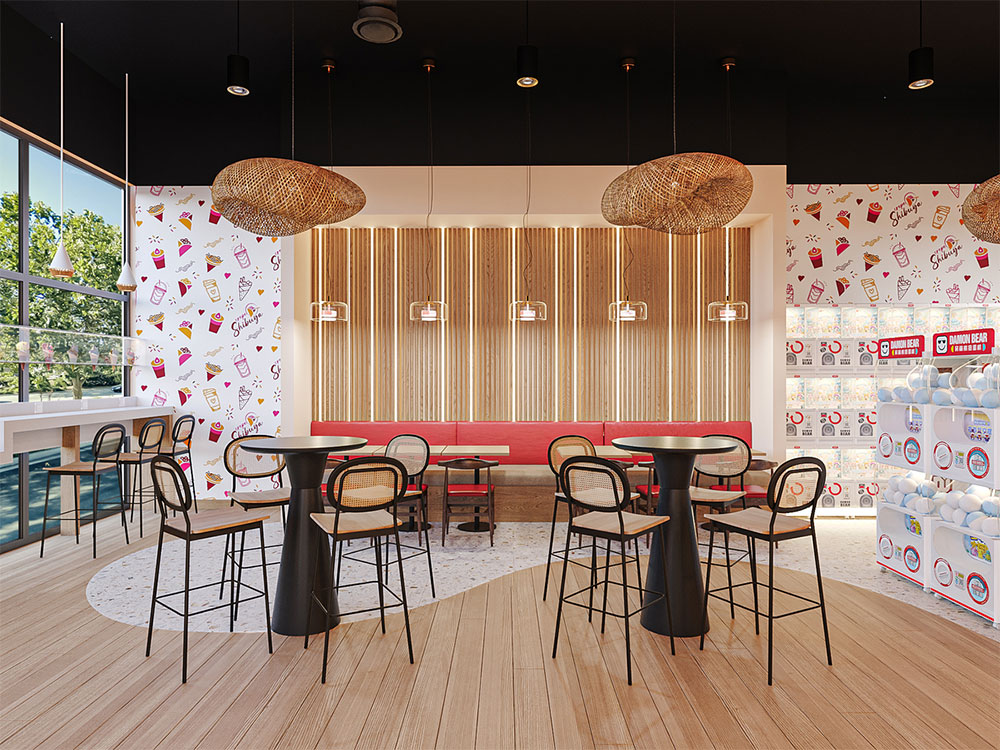
Crepe Shibuya Japanese dessert store design by Mindful Design Consulting.
Design for seasonal experiences
A space can have a permanent identity while still giving customers something new to discover throughout the year.
Of course, seasonal updates do not have to mean redecorating the entire shop every few months. A few carefully planned elements can do much of the work: a feature wall, display window, merchandise area, photo installation or sculptural element can become a rotating stage for different seasons.
For example, a dessert shop could design a large circular installation around its main seating area, with interchangeable elements that transform it throughout the year. In October, it could become an oversized candy-filled spider web; in December, a glowing winter canopy; and in summer, a colorful display of oversized citrus slices and tropical leaves. The permanent architecture remains unchanged while the feature keeps giving regular customers something new to photograph and talk about. That kind of flexibility makes seasonal design part of the experience rather than a temporary decoration added at the last minute.

Give customers a reason to participate
The common thread running through all of these ideas is participation. Customers can watch something being made, customize a dessert, discover a hidden area, interact with an installation, take a photo, browse merchandise or simply choose how they move through the space.
That is very different from a traditional product-first model, where the customer walks in, places an order, receives the product and leaves. The more opportunities customers have to participate, the more the visit becomes an experience they can remember and share.
Participation can be built into fairly ordinary parts of the customer experience. A dessert shop could let customers choose and arrange a set of mini desserts from a display, select the finishing drizzle for a crepe or waffle at the counter, or choose which flavor combinations go into a sampler box. A children’s dessert shop might include a small area where kids can decorate a cookie while an accompanying adult waits for the rest of the order.
Another option is to make the seating area part of the experience. A shop could offer different types of seating for different moods, such as communal tables for groups, comfortable lounge seating for lingering and smaller booths for customers who want a quieter spot. The choices customers make about how they use the space become part of the experience too.
The idea is to give customers small opportunities to make the visit their own. They are still there primarily for the dessert, but the design gives them more ways to participate in what happens around it. That is ultimately what experience-first design is about. The goal is not to turn every dessert shop into an amusement park. It is to find the moments that could be more interesting, more memorable or more engaging and design the space around them.

Leafly Boba Bar design by Mindful Design Consulting.
Mindful Design Consulting is a commercial interior design and branding studio specializing in franchise and multi-location brand expansion. We help growing brands create scalable, consistent, and emotionally engaging environments rooted in the psychology of design. Our work goes beyond aesthetics. We design spaces that influence how customers feel, behave, and connect with a brand.

If you are thinking to open a new business or are in the process of rebranding and remodeling your existing business, contact us to get a free consultation from Mindful Design Consulting. Click HERE to price your project design.
Also, take a look at the “Branding By Interior” e-book, the only book written on this subject at this time. It brings insight into how you can turn your business into a market-dominating competitor by using human cognitive responses.
See our Small Store Design Extravaganza: Commercial Interior Design and Branding 01 book about branding small businesses from logo design to construction, with colorful images, offering insightful explanations every step of the way.