The Hidden Design Process Behind Unforgettable Spaces

Many people assume designers sit around waiting for a burst of inspiration to strike, but that’s not how it works. At Mindful Design Consulting, inspiration isn’t something we wait for, but something we build, step by step. Every project starts with a simple but essential question: what is your business truly offering your customers? Before we think about colors, materials, or furniture, we focus on the message, because that message becomes the foundation for everything that follows.
From there, we move through a clear process that helps us translate that idea into a physical space, step by step. Here is how we do it.
Step 1: Design Goals, Defining the Audience and Direction
Before we begin any design, we establish clear design goals that guide every decision moving forward. This starts with defining the core audience and the exact experience the space should create. A lot of owners try to appeal to everyone, and that is usually where things begin to feel scattered. We guide our clients to focus on one primary audience, because when you design for one group exceptionally well, others are naturally drawn in too. This clarity makes the brand message stronger and the marketing far more effective. From there, every element in the space, from layout to materials to lighting, is aligned with those goals. The result is not just a space that looks good, but one that feels intentional, cohesive, and communicates a clear identity.
Creating a customer avatar is a critical and irreplaceable step in any interior design process.

Step 2: Sketching and Developing the Design Language
This is where everything begins. We start shaping the overall feel of the space through materials, colors, lighting, and textures, but more importantly, every decision is rooted in the brand story and the ideal customer we define from the start.
It often starts very simply, with quick sketches by hand. That process allows us to explore ideas freely, test compositions, and capture the initial feeling of the space before anything becomes too rigid. Those early sketches are where the concept really takes life. We start with the floor plan and examine each wall individually to understand how customers will move through the space and experience it. From there, we map out key lighting fixtures, decide what should be highlighted, and determine where we want to draw attention. This includes areas like merchandise displays, product counters, menus, and photo moments. At the same time, we consider the overall ambient lighting as the space comes together.
This is where the design starts to feel more real, and we begin thinking about how the space will actually function. We look closely at how people move through it, where the key moments are, and how everything works day to day.
These sketches are not just drawings. They are decisions about how the space will feel and operate, and they form the blueprint for both construction drawings and 3D renderings.


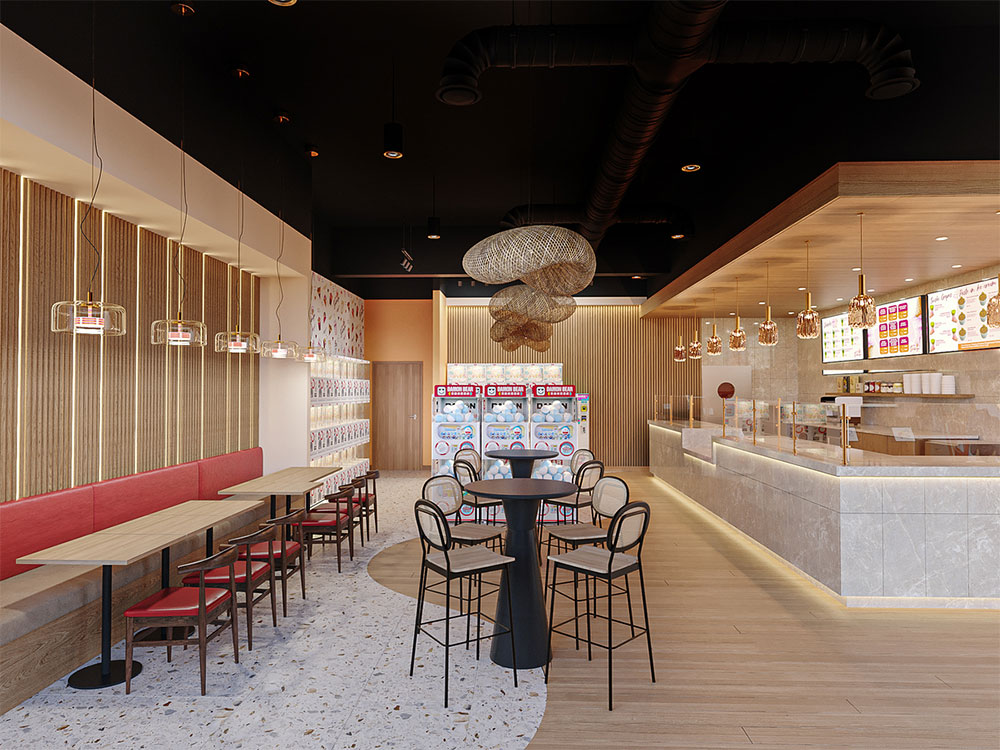
Crepe Shibuya Japanese dessert store design by Mindful Design Consulting
Step 3: Bringing Branding into the Space
This is one of the things we pay the most attention to. Graphics and visual elements are not an afterthought. They are embedded into the design from the very beginning.
We focus on:
- The style and color of the logo
- Translating graphical elements into the space
- Wall graphics designed to create photo-worthy moments
- Signage that reinforces the brand character
- Menu boards that align with the brand’s voice
- Any other small visual details
Everything we do comes from what the business is trying to communicate to its customers. This is often the moment when the space truly begins to feel like a brand in physical form.


Swirlicious frozen dessert store design by Mindful Design Consulting
Step 4: Exploring Ideas with AI and References
Now it’s time to start exploring ideas. We look at references, materials, and increasingly, we use AI to test different directions. This helps us try different styles quickly, experiment with combinations we might not have thought of, and visualize lighting and textures early in the process.
AI does not replace design. It simply allows us to explore more options faster. Instead of committing to one idea right away, we can test many and pull the elements that truly align with the vision.
This phase is often one of the most exciting for our clients. We can move quickly, explore different settings, and see what works and what does not before anything is finalized. We use a mix of tools, from MidJourney to Nano Banana and others, to generate images and even short videos on the fly.

Juice Store concept AI design by Mindful Design Consulting

Chocolate Store concept AI design by Mindful Design Consulting
Step 5: 3D Renderings: Bringing It All Together
Finally, the 3D renderings allow us to see the space clearly in a visual way. Instead of imagining the space, you can actually see how the layout, lighting, materials, and other design elements will look and feel. Seeing everything together makes it much easier to understand how all the elements connect and work as a whole.
Details that were abstract before, such as lighting, materials, and proportions, become much more obvious. This also makes it easier to spot anything that needs adjusting before construction begins.
At this stage, the design begins to feel real. You can start to imagine walking into the space and experiencing it firsthand. Using the latest AI tools, we enhance our 3D renderings to make them more realistic and even transform them into videos of a fully functioning space.

Boba Nation franchise store design by Mindful Design Consulting
Step 6: Refining Everything to Fit Real Life
This is where design meets reality. We review every element and make adjustments based on budget, material availability, client feedback, and any new ideas that come up along the way. Things often evolve at this stage, and that is completely part of the process.
The goal is to stay true to the original vision while making sure the design actually works in the real world. This final step ensures the space is not only beautiful but also functional, practical, and ready to be experienced as intended.

Photo of Taco Time restaurant in La Jolla, design by Mindful Design Consulting

Photo of Taco Time restaurant in La Jolla, design by Mindful Design Consulting
So Where Do Design Ideas Come From?
At the heart of it, when people ask where design ideas come from, the answer is that it is rarely a single moment of inspiration. It is a step-by-step process. It begins with understanding the business goals and what the business is truly offering. From there, we build the design language around the brand and the ideal customer.
Next, we layer in branding so the space communicates the story clearly. We explore different directions using references and AI to test ideas and then translate those ideas into layouts that shape how people move through and experience the space. Once everything comes together in 3D, we can see how all the elements connect. Finally, we refine the design to make sure it works in real-world conditions, including budget, materials, and construction.
By the end of the process, the space feels intentional, cohesive, and ready to tell the brand story to every customer who walks through the door.

Bobaroma boba tea store design by Mindful Design Consulting
If you are thinking to open a new business or are in the process of rebranding and remodeling your existing business, contact us to get a free consultation from Mindful Design Consulting. Click HERE to price your project design.
Also, take a look at the “Branding By Interior” e-book, the only book written on this subject at this time. It brings insight into how you can turn your business into a market-dominating competitor by using human cognitive responses.
See our Small Store Design Extravaganza: Commercial Interior Design and Branding 01 book about branding small businesses from logo design to construction, with colorful images, offering insightful explanations every step of the way.