How Scalable Franchise Design Turns One Location into a Successful Chain

Opening your first store is an emotional experience. It’s fueled by instinct, hustle, and a clear vision of how you want people to feel the moment they step inside. Maybe it’s a pastel-filled dessert shop, a lively boba tea bar, a self-serve frozen yogurt spot, or a fast-casual restaurant with its own signature vibe. Whatever the concept, that first location captures the brand in its purest form.
But everything changes when you move from one store to two, and then to even more. Suddenly, you’re not just designing a space, but building a system. That is where interior design either becomes the engine that drives growth or the roadblock that slows it down, and where scalable franchise design becomes your key to success.

Design of Boba Nation in Texas mall location. Design by Mindful Design Consulting.
Designing a Store vs. Designing a System
Your first store is typically designed around a specific space, budget, and burst of creative energy. The layout responds to that exact footprint, the finishes are chosen based on what is available at the time, and details evolve organically during construction. It works very well because it’s highly tailored.
However, when you start expanding, that level of customization becomes difficult to sustain.
Designing a system requires stepping back and identifying what truly defines the brand. Is it the counter configuration? The material contrast? The lighting mood? The way customers move from entry to pickup? Once those core elements are identified, they need to be documented and structured so they can be repeated with consistency.
When brands like Boba Nation and Kung Fu Tea expanded beyond their original markets, their growth wasn’t powered by copying a single store layout over and over. It was powered by developing adaptable prototypes that preserved brand identity while accommodating different footprints.
The difference between a nice idea and a scalable brand is having a scalable franchise design, or a system you can repeat.

Design of Boba Nation in Texas mall location. Design by Mindful Design Consulting.
Where Growing Brands Often Go Wrong
Many dessert stores, frozen yogurt shops, and quick-service beverage concepts run into similar issues once they begin expanding. The original design was thoughtful and exciting, but it was not built for replication. Here is what usally goes wrong:
Over-customization. Custom fixtures, imported tile, specialty lighting, and fully custom millwork might look amazing in your first store, but they can turn into headaches once you’re trying to build in multiple markets. Suddenly you’re dealing with long lead times, price swings, and contractors interpreting details differently, which can slow your growth dramatically.
No prototype layout. Without a standardized plan, every new location starts to feel like you’re figuring it out all over again: counters move, equipment gets rearranged, back-of-house space gets tighter, and the customer flow ends up a little different each time. The store might still look great, but behind the scenes things get less consistent, and over time the brand starts to feel less clear and cohesive.
Finish inconsistency. If one franchisee switches materials to save money and another upgrades finishes on their own, the brand can start to look different from store to store. Over time, that inconsistency makes it harder for customers to instantly recognize you and can chip away at the trust you’ve worked so hard to build.
Designing for Instagram, not for operations. In highly visual concepts like dessert and boba shops, there is often a temptation to prioritize social-media-ready moments over operational logic. Statement walls and photo-ready lighting matter, but if the queue blocks the entrance or staff workflow is inefficient, the great look doesn’t make up for daily operational headaches.

Design of Boba Nation in Scottsdale, Arizona. Design by Mindful Design Consulting.
Why Prototype Layouts Work
Introducing a prototype layout is often the turning point for brands moving from a handful of stores to a broader rollout. Instead of treating each new location as a completely new project, a prototype gives you a repeatable framework that makes expansion much easier.
A prototype is not about copying and pasting a floor plan into every new lease space, but about establishing a core spatial logic that can adapt. A strong prototype lays out everything clearly: the best counter lengths, where equipment should go, prep zones, storage areas, modular seating configurations that scale up or down depending on square footage, and even how customers move through the space from entry to order to exit. The key is that the layout is flexible enough to work in different store sizes without messing up operations.
With a prototype in place, you don’t have to start from scratch every time. You can adjust a proven system to fit the new space, which makes design faster, construction smoother, and permits easier to handle. Plus, having a documented prototype gives the franchisees confidence that they’re investing in a setup that works, not a concept that is constantly changing.
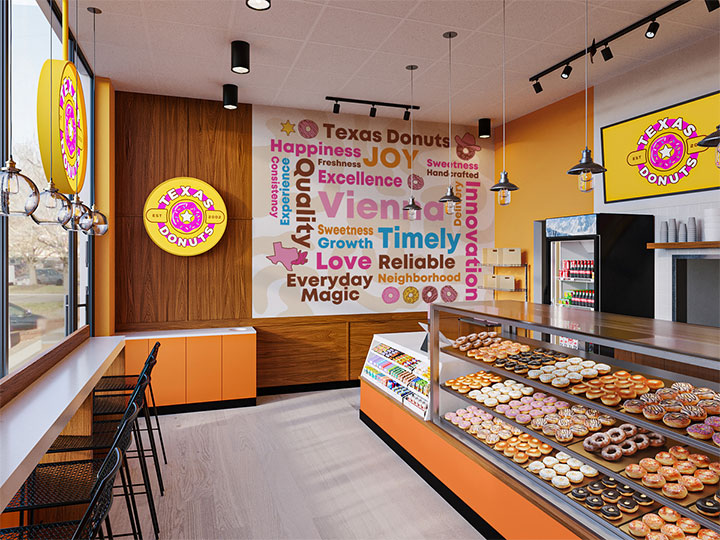
Design of Texas Donuts store, 1st location in Scottsdale, Arizona. Design by Mindful Design Consulting.
Finish Palettes That Work in Multiple Footprints
Beyond the layout, the smartest thing a growing brand can do is settle on a controlled finish palette. This doesn’t mean stripping personality out of the space, but refining it into a concise, repeatable kit.
A strong palette might include:
- 2 approved flooring options
- 1 primary tile
- 1 accent tile
- 2–3 laminate selections
- A standard paint schedule
- Defined lighting package.
By defining these details, you’re reinforcing the same visual language repeatedly. From a practical standpoint, a controlled finish palette simplifies bidding and procurement, reduces value-engineering surprises, and shortens project timelines. From a brand perspective, it ensures customers know exactly who you are the moment they step inside, no matter which city they’re in.
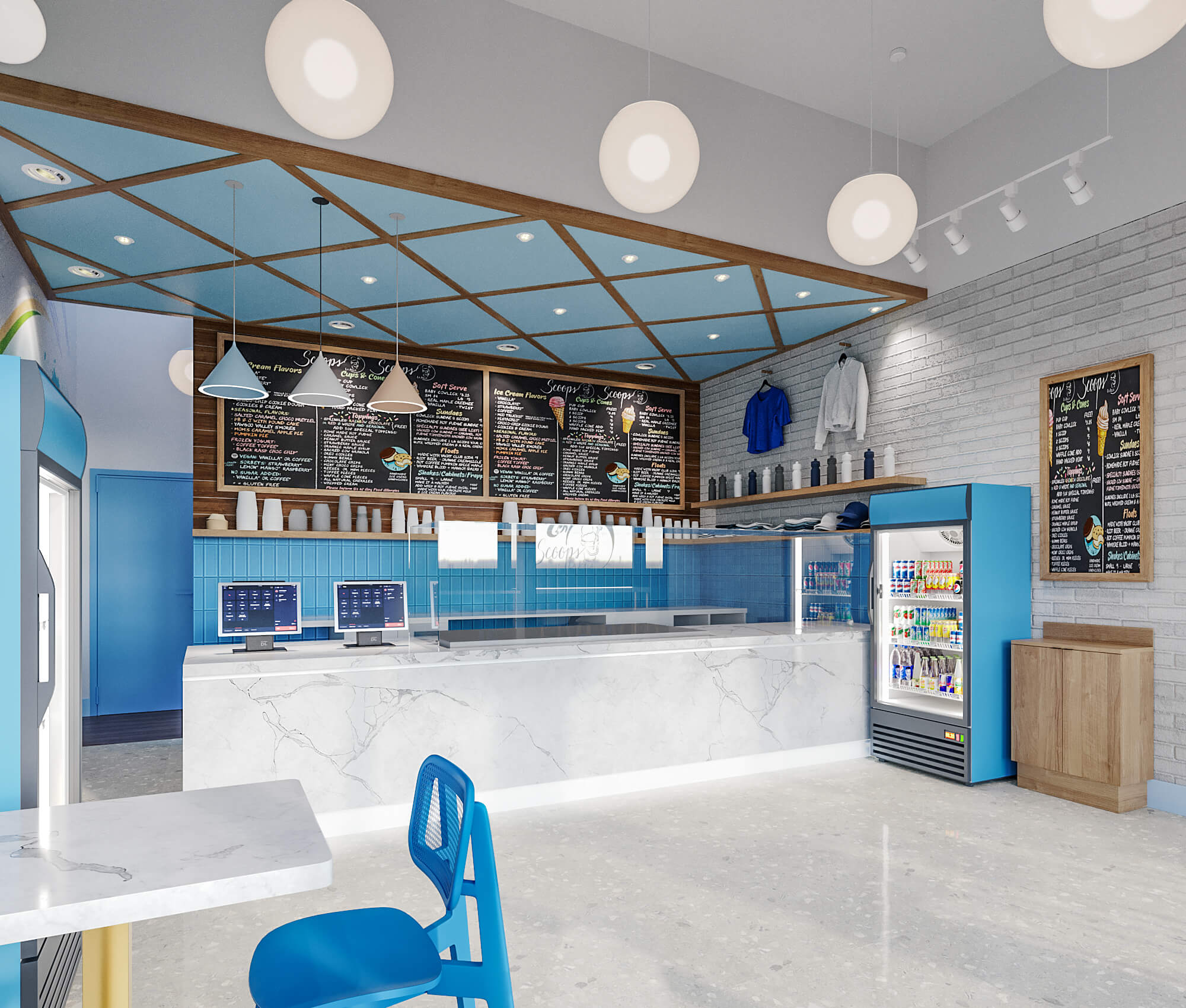
Design of Scoops La Jolla 3rd location in California. Design by Mindful Design Consulting.
The Financial Advantage of “Design Once, Use Many Times”
One of the most underestimated costs in early-stage growth is repeated design work. Every time a brand starts over with a new layout, new details, and new specifications, it incurs additional architectural hours, consultant coordination, rendering fees, and permitting adjustments.
When you multiply that process across five or ten stores, the soft costs alone become significant.
By contrast, investing upfront in a documented prototype, standardized millwork details, fixture schedules, and adaptable construction drawings allows you to simplify the design effort across multiple openings. The result of this scalable franchise design is faster rollout, fewer surprises, and greater confidence from franchisees or investors who see a proven system rather than a constantly evolving experiment.
Standardization, in this context, is not about limiting creativity. It’s about protecting margins and enabling sustainable growth.

Design of Scoops La Jolla 2nd location in La Jolla, California. Design by Mindful Design Consulting.
The Founder Mindset Shift
Perhaps the most challenging transition is psychological. Founders often approach each new location as an opportunity to outdo the last one. While continuous improvement is important, constant reinvention can create operational instability and brand inconsistency.
Scaling successfully requires a shift from designing your most exciting store to designing your most repeatable store. It’s about refinement rather than reinvention, discipline rather than spontaneity.
When that mindset changes, growth becomes more predictable and far less chaotic.

Design of Scoops La Jolla 1st location in La Jolla, California. Design by Mindful Design Consulting.
How We Support the Transition to Scalable Franchise Design
At Mindful Design Consulting, we often partner with brands right at the inflection point between a few successful locations and a larger expansion strategy. These companies may not yet see themselves as “big,” but they are growing quickly enough that their design process needs structure.
Our role goes beyond creating an attractive dessert shop, frozen yogurt bar, or restaurant interior. Here are some tasks we help founders with:
- Translate the original vision into a scalable prototype
- Build adaptable layouts for different square footages
- Create finish palettes that are vendor-accessible
- Develop millwork and fixture standards
- Document everything into a repeatable kit.
The outcome is a brand that can open its seventh or tenth location with the same level of intentionality as its first, but with far greater efficiency and profitability.
If you’re expanding to multiple locations, we can help you build franchise interior guidelines that protect your brand and simplify scaling.

The facade of Scoops La Jolla ice-cream store first location in La Jolla, California, after the remodel using scalable franchise design. By Mindful Design Consulting.
If you are thinking to open a new business or are in the process of rebranding and remodeling your existing business, contact us to get a free consultation from Mindful Design Consulting. Click HERE to price your project design.
Also, take a look at the “Branding By Interior” e-book, the only book written on this subject at this time. It brings insight into how you can turn your business into a market-dominating competitor by using human cognitive responses.
See our Small Store Design Extravaganza: Commercial Interior Design and Branding 01 book about branding small businesses from logo design to construction, with colorful images, offering insightful explanations every step of the way.